
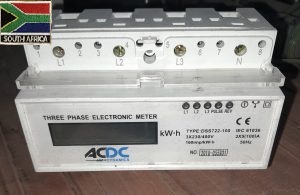
A three-phase kilowatt-hour (kWh) meter, also called a three-phase energy meter, measures electrical energy consumption in three-phase AC power systems. These are common in commercial, industrial, and larger residential setups (e.g., those with heavy machinery, pumps, or high loads) that use three-phase supply for efficiency and power delivery.
Why Use a Three-Phase Meter?
- Single-phase meters suit homes with simpler loads.
- Three-phase meters handle balanced or unbalanced loads across three phases (L1, L2, L3), often with a neutral (3-phase 4-wire) or without (3-phase 3-wire).
- They calculate total energy in kWh by measuring voltage, current, and power factor across phases, then integrating power over time.
Main Types
- Electromechanical (Induction Type) — Older style with rotating discs. Durable but less precise; total energy sums torques from multiple elements.
- Electronic/Digital (Solid-State) — Modern standard. Uses microprocessors for high accuracy, LCD displays, and often supports features like pulse output, RS485/Modbus communication, or smart metering.
- Smart Meters — Advanced digital versions with remote reading, real-time monitoring, load profiling, and two-way communication.
- Direct/Whole-Current vs. CT-Operated (Indirect):
- Direct: For lower currents (e.g., up to 100A).
- CT-operated: Uses current transformers for high-current systems (safer and more common in industry).
Common specs include ratings like 3×230/400V, current ratings (e.g., 5(80)A direct or 5A CT), accuracy class 1 or 0.5, and support for 3-wire or 4-wire systems.
How It Works
- It samples voltage and current on each phase.
- Calculates instantaneous power (active/reactive/apparent).
- Integrates over time to get kWh (and often kVArh or other parameters).
- For CT types, current transformers step down high currents for safe measurement.
Typical Wiring (3-Phase 4-Wire Example)
A standard 3-phase 4-wire meter (e.g., 400V) has terminals for:
- Three phase lines (L1, L2, L3) — incoming and outgoing.
- Neutral (N).
- Sometimes voltage reference and CT secondaries (S1/S2 for each phase).
Basic connection steps (always follow local codes and use a qualified electrician):
- Incoming supply from the main breaker/transformer to meter inputs.
- Outgoing from meter to distribution board.
- Neutral passes through.
- For CT meters: CTs on each phase line, with secondaries wired to meter.
Wiring diagrams vary by model (direct vs. CT, 3-wire vs. 4-wire). Search for your specific model or refer to manufacturer docs (e.g., IEC standards).
Key Features on Modern Meters
- LCD display showing total kWh, per-phase values, instantaneous kW, voltage, current, power factor.
- Pulse output for external logging.
- Communication ports (RS485, etc.).
- Tamper detection and diagnostics.
Applications
- Factories and workshops.
- Commercial buildings.
- Large homes or farms with three-phase supply.
- Solar/net metering setups.
- Sub-metering in apartments or RV parks.
Safety Note: Installing or modifying a kWh meter involves high voltage. It must comply with local utility regulations and should only be done by a licensed electrician. Incorrect wiring can cause damage, inaccurate readings, or safety hazards.
If you’re looking for a specific model, wiring diagram for your setup, how to read one, purchasing options, or troubleshooting, provide more details (e.g., voltage, current rating, direct or CT type)!