
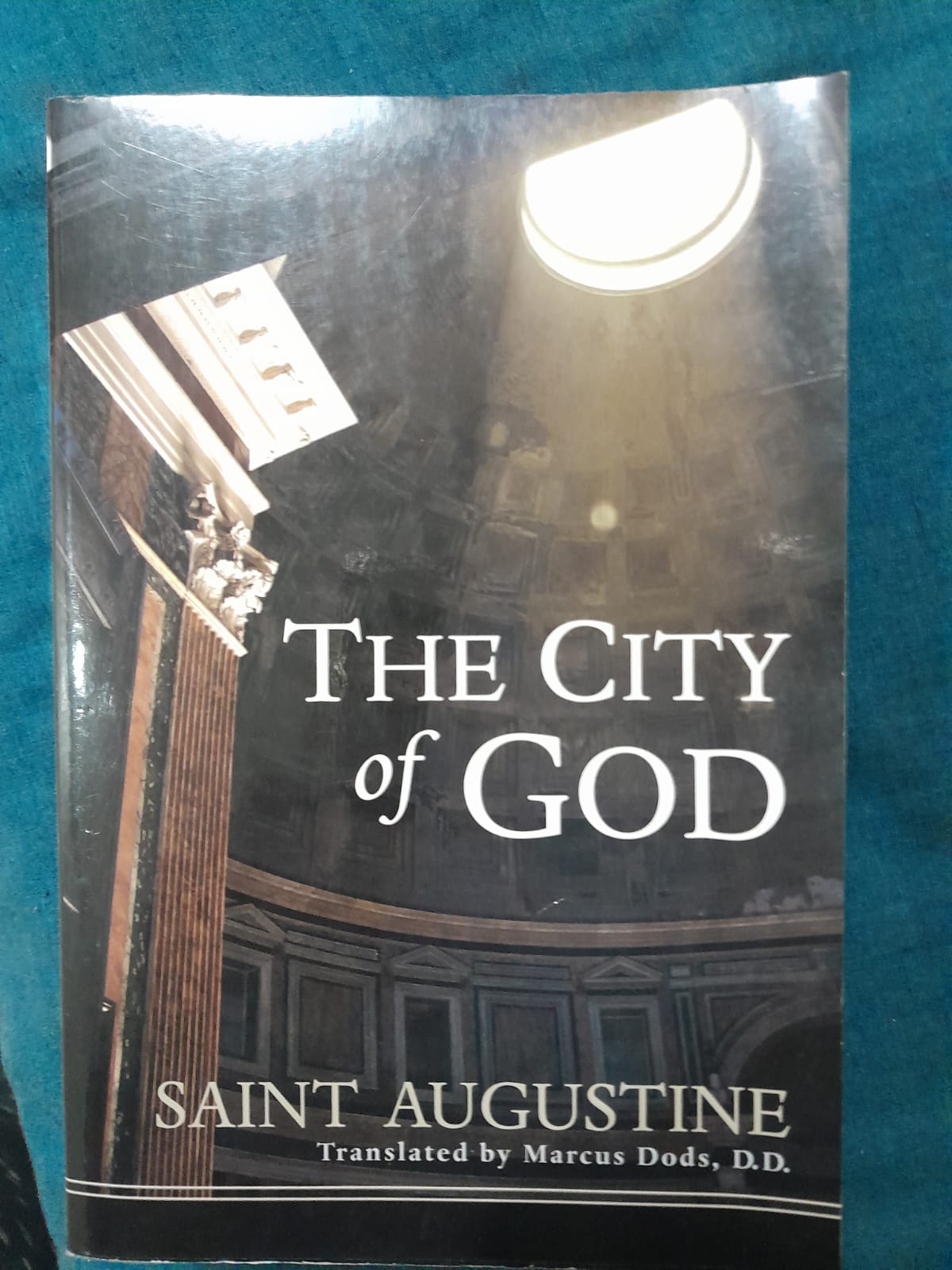
The City of God (De Civitate Dei contra Paganos, or On the City of God Against the Pagans) is a monumental work of Christian philosophy and theology by Saint Augustine of Hippo (354–430 AD), written between approximately 413 and 426/427 AD.
It stands as one of his most important books, alongside Confessions, and a cornerstone of Western thought.
Historical Context
Augustine, Bishop of Hippo in North Africa, wrote it in response to the sack of Rome by the Visigoths under Alaric in 410 AD. This event shocked the Roman world. Many pagans blamed the rise of Christianity (and the abandonment of traditional Roman gods) for Rome’s decline and misfortunes.
Augustine refuted these claims, defended Christianity, consoled believers, and offered a broader theological vision of history. He argued that disasters had plagued Rome long before Christianity, and that the faith had actually mitigated the sack’s horrors (e.g., Gothic Christians spared sanctuaries).
Structure
The work spans 22 books (a massive text by ancient standards):
- Books 1–10: Refute paganism. Augustine critiques Roman religion, philosophy (including Platonism), and claims of divine protection by the old gods. He shows that moral and physical calamities occurred under pagan worship.
- Books 11–22: Develop the positive vision of the two cities, tracing human history from creation through biblical narrative to the end times, judgment, and eternity.
Central Theme: The Two Cities
This is Augustine’s most famous contribution here. He describes two intertwined societies or “cities” that run through all of history:
- The City of God (or Heavenly City): Composed of those who love God above all else (even to the point of self-denial). Its members are pilgrims on earth, oriented toward eternal peace, fellowship with God, and the ultimate triumph at the end of time.
- The City of Man (or Earthly City): Composed of those who love themselves or earthly things above God. It seeks temporal power, glory, and pleasures, and is ultimately doomed (though it can produce relative goods like order and justice in this life).
These cities are intermingled in the present world (like wheat and tares in the biblical parable) and will only be fully separated at the Last Judgment. Christians live as citizens of both but owe ultimate allegiance to the City of God.
Augustine frames all history as a spiritual conflict between faith and unbelief, ultimately ending in victory for the City of God.
Key Themes
- Theodicy and evil — Why the righteous suffer; the origin of evil (pride and turning from God); free will and divine providence.
- True peace and happiness — Found only in God, not in earthly empires or goods.
- Linear view of history — Unlike cyclical pagan views, history has a beginning (Creation), direction, and end (Second Coming and Judgment).
- Church and state — Earthly governments have a role in restraining sin, but they are not ultimate. Later thinkers drew on this for ideas about church-state relations.
- Pilgrimage — Believers are sojourners in this world.
The book also covers creation, angels, original sin, resurrection, and much more—functioning almost as a theological compendium.
Significance
The City of God profoundly shaped medieval Christianity, Western philosophy, historiography, and political thought. It influenced figures like Thomas Aquinas and John Calvin, and offered a Christian counter to Plato’s Republic. It remains relevant for discussions of faith, culture, politics, evil, and hope amid worldly turmoil.
It is a dense, rewarding read—long and sometimes discursive, but full of powerful insights. Modern editions often come with introductions or summaries to help navigate it.